
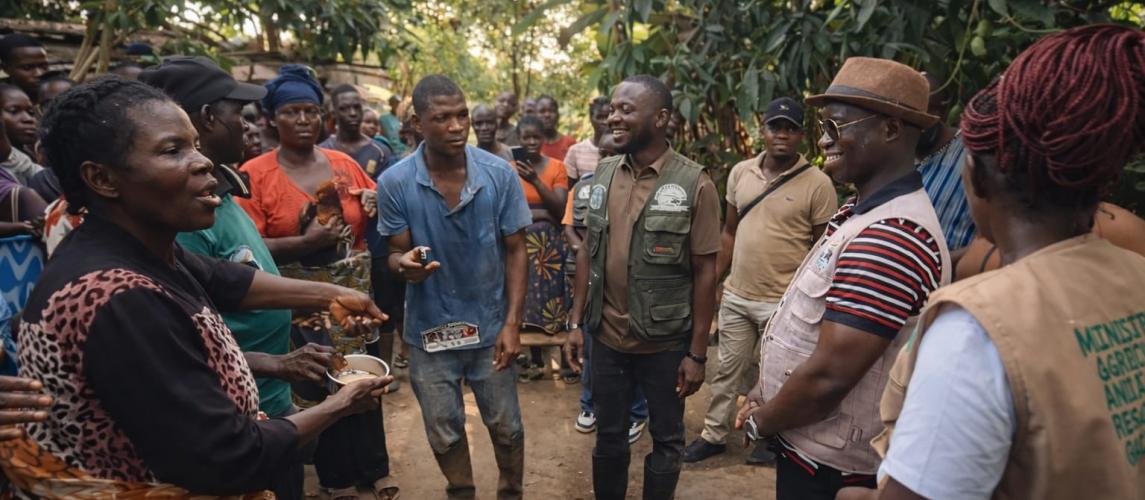
Bong County, March 19, 2026 – The Ministry of Agriculture has reaffirmed its commitment to achieving national food self-sufficiency, with a renewed focus on direct engagement with farmers and on expanding agricultural production across the country.
As part of an ongoing nationwide tour, Agriculture Minister Dr. J. Alexander Nuetah is leading high-level interactions with farming communities to assess progress, identify challenges, and strengthen support mechanisms. The current phase of the tour began in Bong County, following earlier engagements in southeastern Liberia, and will continue across Margibi and Montserrado counties.
Initial field observations indicate encouraging progress, with many farmers independently initiating cultivation as early as January this year. Within a short period, visible results have demonstrated strong willingness and commitment among rural farmers to scale up production, particularly in rice cultivation.
“This level of initiative from our farmers is a clear signal that Liberians are ready to feed themselves,” Dr. Nuetah noted. “Our role now is to reinforce these efforts by expanding support and creating the conditions necessary for sustained productivity.”
In line with the Government’s national agricultural development agenda, Liberia is targeting the development of 7,400 hectares of lowland rice across the country this year. As part of its broader target to cultivate 50,000 hectares of lowland rice by 2030, the Ministry of Agriculture has announced plans to cultivate over 1,400 hectares in Bong County, creating significant opportunities for increased production and local participation.
“We are scaling up lowland rice development not just to increase production, but to create jobs, strengthen rural livelihoods, and reduce our dependence on imported rice,” Dr. Nuetah added. “Bong County is central to this effort, and we are confident that with the right support, our farmers will deliver.”
The Ministry emphasized that while demand from farmers continues to grow, available resources are being strategically deployed to ensure maximum impact within the targeted areas, with ongoing support from government interventions and key agricultural projects, including SADFONS, IFAD-supported programs, RETRAP, and STAR.
The Government remains committed to empowering farmers, increasing domestic food production, and reducing reliance on imports. Through sustained investment, strategic partnerships, and community-driven initiatives, the country is taking bold steps toward a more food-secure future.
