
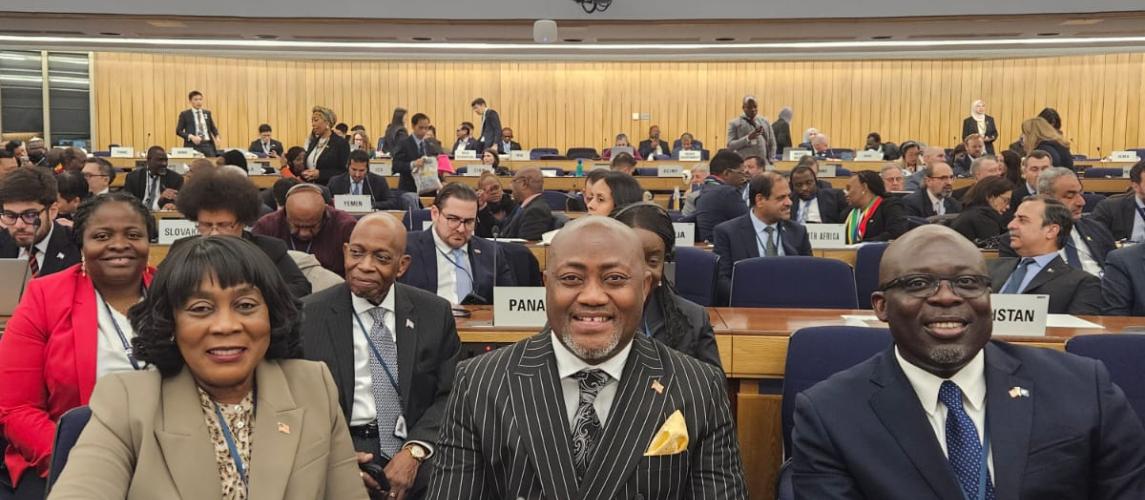
Liberia Sets a Significant Milestone by Getting Re-elected at the Category A Level of the International Maritime Organization’s Council
Liberia has secured its spot back on the International Maritime Organization’s Council for the 2026-2027 biennium at the organization’s 34th Assembly session, ending a twenty-eight-year gap since losing the seat in 1995.
The reinstatement came with the unprecedented 141 votes announced at the IMO headquarters in London on Friday, November 28, placing the country in Category A. No doubt, this is an epic feat earned. Record style and fashion, and, of course, has secured a page in the history books.
Category (A) comprises global shipping giants like Greece, Norway, the USA, Japan, the United Kingdom, China, etc. These are countries with the largest interest in providing international shipping services. This win enables Liberia to help shape global rules on shipping, safety, ocean protection, and maritime security, areas vital for a country with a long coastline and a premier ship registry program.
This return strengthens Liberia’s voice on the world stage, especially as shipping faces challenges like climate change, human trafficking, and piracy.
But what does it mean for everyday folks and the economy? According to Ambassador Robert Wilmot Kpadeh, Liberia’s Permanent Representative to the IMO, he breaks it down in a post-election interview on Friday evening at the headquarters of the IMO in London, the United Kingdom. Liberia’s reelection to Category (A) of the IMO first put the country front and center of global maritime diplomacy. It also puts the country in a strategic position to make direct input into key decision-making at the IMO, such as setting the year-long work program and budget of the IMO and subsequently approving it. In so doing, Liberia can continue to make the case for funding and financial assistance to improve Liberia’s maritime capacity in areas such as Search and Rescue of distressed persons at sea, thereby equipping the nations Search and Resuce Coordination Center (MRCC) located in Bong Mines Bridge on the Bushrod Island, something our seafarers and fishermen will benefit from in terms of safety. Also, Liberia can make the case for technical assistance and funding for the improvement of the only maritime school in Liberia (Liberia Maritime Training Institute) in Marshall, Margibi County, where young Liberians can acquire marketable maritime education and training to pursue quality jobs in the global maritime industry.
According to him, as an import-reliant economy, Liberia heavily depends on its seaports for goods that are consumed on the market. Therefore, the regulations and standards that are set by the global body go a long way in affecting port tariffs levied on vessels calling to our ports, as well as customs duties and port fees imposed, which port users bear and subsequently are passed on to end users in the wider market through high prices of goods and services. Thus, if the right and reasonable standards are set and regulations enforced, it will improve port effectiveness and help to reduce the price of goods and services.
Ambassador. Kpadeh lamented further that, as a major maritime nation with the highest number of registered fleets worldwide, it allows us to push for policies and regulations that would favor our vessels and seafarers and the respective markets they serve. He also stated that Liberia will be the voice of the developing world in ensuring that emanating regulations and policies are exercised on a just and equitable basis, without any favorable treatment, and no country left behind. He also stressed that when the proper case is made for capacity building and funding, it will affect key areas such as education and training, and the improvement of maritime security in an effort to curb piracy, armed robbery at sea, and Illegal, Unreported and Unregulated fishing (IUU) in the sub-region.
The International Maritime Organization (IMO) has concluded its yearlong work program and will go on recess for the year 2025 to begin active duties under the leader of the Assembly for which Liberia sits pretty on the level of Category (A) on the Council with other big maritime nations like China, Greece, Italy, Japan, Norway, Panama, the Republic of Korea, the United Kingdom and the United States.
From across the world, flurries of congratulatory messages have been flowing the way of the government and people of Liberia for such magnificent and historic win.
