
President Boakai Breaks Ground for Major Electrification Project for Bomi, Gbarpolu and Grand Cape Mount ~Assures that, “No County Will Be Left in the Dark”
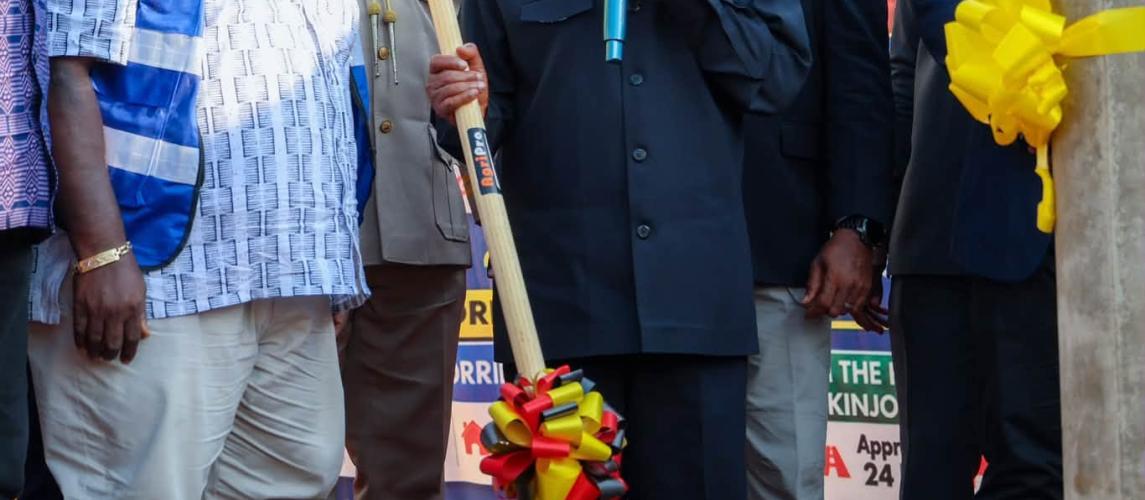
Speaking on Friday at the Commissioner’s Compound in Clay, Bomi County, President Boakai said the initiative represents a practical step toward fulfilling his promise to ensure that development reaches every part of Liberia, rather than remaining concentrated in Monrovia.
“When I took the oath of office, I made a promise that development in Liberia would no longer stop at the edge of Monrovia,” the President recalled. “Today, we put that promise into the ground.”
The project will extend the national electricity grid from Tubmanburg to Bopolu City in Gbarpolu County, connecting communities along the route. Additionally, a transmission line will run from Sawmill, Gbarpolu County, to Lofa Bridge. In Grand Cape Mount County, electricity will be extended to Kinjor and surrounding communities along the Kinjor Corridor.
Upon completion, approximately 7,033 households, schools, clinics and businesses are expected to benefit, reaching an estimated 35,165 people.
The project will involve the construction of approximately 101 kilometers of 33-kilovolt overhead distribution lines and 86 kilometers of secondary distribution networks, serving 18 towns. The Liberia Electricity Corporation (LEC) said the initiative is being financed entirely from its own resources and implemented by 12 Liberian contractors across 14 project lots.
Describing himself as a son of Lofa and a neighbor to the people of Gbarpolu, the President said he understands the County’s prolonged wait for electricity, noting its historical ties to Lofa.
“To the people of Gbarpolu, I say: your wait is coming to an end,” he assured residents, adding that the expansion would bring new opportunities for households, institutions and businesses.
President Boakai stressed that electricity is central to the Government’s ARREST Agenda for Inclusive Development, describing it as a necessity for agricultural productivity, education, healthcare, public safety and investment.
He reiterated his earlier announcement that Liberia would manufacture its own transformers. He also reaffirmed his Government’s commitment to raising national electricity access to 75 percent by 2030 under the Mission 300 National Energy Compact.
President Boakai highlighted LEC’s expanding operations, disclosing that the corporation currently serves more than 400,000 customers and continues to connect thousands of additional households and businesses. He commended the corporation’s Board of Directors, management and staff for mobilizing the financial resources required for the expansion, while recognizing the contributions of contractors and other institutions involved.
The President warned that the groundbreaking ceremony must translate into timely and accountable project delivery. He charged LEC and the contractors to complete the work to the highest standards, insisting that every dollar invested must be accounted for.
The Liberian Leader also called on legislative caucuses, county superintendents and local authorities to cooperate with the corporation in securing rights of way and keeping residents informed throughout implementation.
Further, President Boakai urged communities to protect the electricity infrastructure against vandalism, cable theft and illegal connections, warning that anyone involved in such acts would face the full force of the law. He also reminded prospective customers that electricity services must be paid for, stressing that revenue collection is essential to sustaining operations and extending electricity to additional communities.
“Electricity is not free anywhere. We must pay our bills to continue to benefit,” he cautioned.
Concluding his address, President Boakai said the Project should become part of a broader national effort to ensure that geographical location no longer determines access to basic infrastructure and economic opportunities.
“When the history of this period is written, let it be said that this was the time Liberia decided that no county would be left in the dark and without connection by paved road.”
Senior government officials who spoke at the occasion and highlighted the significance of the initiative included the Managing Director of the Liberia Electricity Corporation, Honorable Mohammed Sherif; Senator Edwin Melvin Snowe, who chairs the Senate Committee on Hydrocarbon, Energy and Environment; Bomi County Legislative Caucus Chairman, Senator J. Alex Tyler; and Bomi County Superintendent Sam Zinnah.
Representatives of the Ministry of Mines and Energy and the Liberia Electricity Regulatory Authority also delivered messages of goodwill.
